The article provides detailed information on varicocele and the role of robotic varicocelectomy in treating it.
Let's deep dive into the article to get more information.
What is a Varicocele?
Varicocele is a condition in which there is a pathologic dilation of the testicular veins within the spermatic cord.
What is the prevalence rate of varicocele?
The prevalence rate of varicocele is 15 % in adult males. Of those presenting for evaluation of infertility, nearly 35% have varicocele.
What does varicocele cause?
The varicocele causes:
-
Poor development of a testicle.
-
Low sperm production
-
Low testosterone
-
Infertility
-
Orchialgia (testicular pain)
-
Testicular atrophy
-
Disruption of key enzymes of spermatogenesis.

What are the advantages of varicocele treatment?
The advantages of varicocele treatment are:
-
Treats infertility.
-
Improvement in semen analyses.
-
Relief from constant testicular pain
-
Increase in testosterone levels
-
Reduce complications
What are the indications of varicocelectomy?
The indications of varicocelectomy are:
-
Infertility due to impaired semen parameters and quality.
-
Pain in the scrotum
-
Hypotrophy of testicles
-
Hypogonadism

Considering Urology Treatment abroad?
Share a few details and a Yapita Health medical advisor will get back to you with personalised guidance and a free, no-obligation cost estimate.
- Response within 24 hours · 100% confidential
- Vetted hospitals & board-certified doctors
- End-to-end travel & treatment support
What are the benefits of robotic varicocelectomy in the treatment of varicocele?
The benefits of robotic varicocelectomy in the treatment of varicocele are:
-
Elimination of tremors
-
Precision of surgery
-
Improvement in sperm count
-
Resolution of pain
-
Low failure rate
-
Fewer complications
What is the difference between robotic and conventional varicocelectomy?
| Robotic Varicocelectomy | Conventional Varicocelectomy |
|
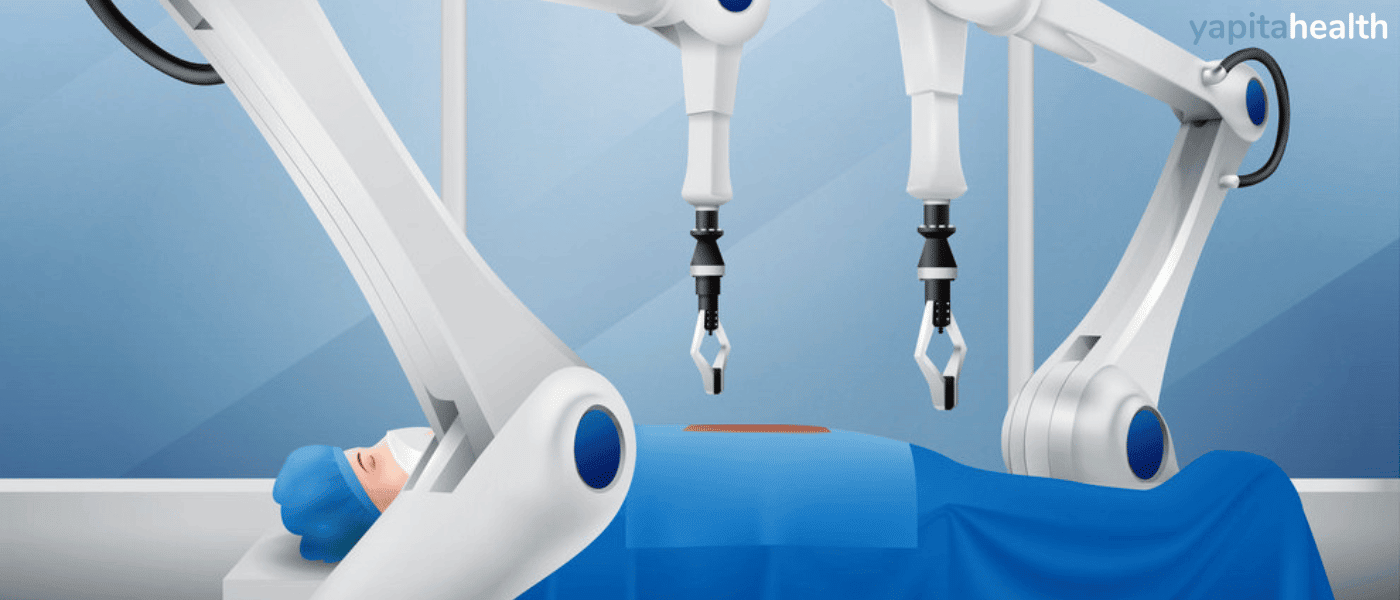
The robotic arm performs the procedure using small incisions. |
Incisions are used and the procedure is carried out under the surgeon's visual inspection. |
|
There is less risk of tissue trauma. |
There is a risk of tissue trauma. |
|
Short recovery time. |
Long recovery time. |
|
Fewer complications. |
High risk of complications like hematoma, hydrocele, and infection. |
|
No risk of scarring. |
Incisions may lead to scarring. |
|
Greater visualization and high precision. |
Limited visualization and precision. |
Who treats varicoceles?
Varicoceles are treated by Urologist.
A urologist specializes in diagnosing and treating diseases of the urinary system.
The urinary system includes:
-
Kidneys
-
Bladder
-
Ureters
-
Urethra
What research says about robotic varicocelectomy?
Based on the findings from numerous studies, the following conclusion can be drawn.
-
The time range in robotic varicocelectomy is 10-150 minutes.
-
The procedure improves sperm count and mobility.
-
There is reduced testicular pain.
What are the types of robotic varicocelectomy?
The types of robotic varicocelectomy are:
-
Robotic-Assisted Microscopic Varicocelectomy
-
Robotic-Assisted Laparoscopic Varicocelectom
What are the steps in robotic varicocelectomy?
The steps in robotic varicocelectomy are:
-
The patient is given general anesthesia.
-
Positioning of robotic arms and camera.
-
Small incisions are given in the abdomen
-
The camera is inserted to provide a 3D view of the surgical site.
-
Identification of spermatic cord and the veins involved in varicocele.
-
The robotic instruments isolate and clip the vein.
-
The blood flow to the veins is then cut off.
-
Removal of varicocele.
-
Incision closure.
-
Follow-up.
What are the Postoperative instructions generally followed after varicocelectomy?
Following robotic varicocelectomy, hospitalization is not required.
Some general post-operative instructions are:
-
Cold compression.
-
Instructions are given by the surgeon to take care of the wound properly.
-
Painkillers are prescribed.
-
Heavy lifting is avoided.
-
The appointment is scheduled within 4 to 6 months for assessment of sperm quality.